AI for College Lecturers
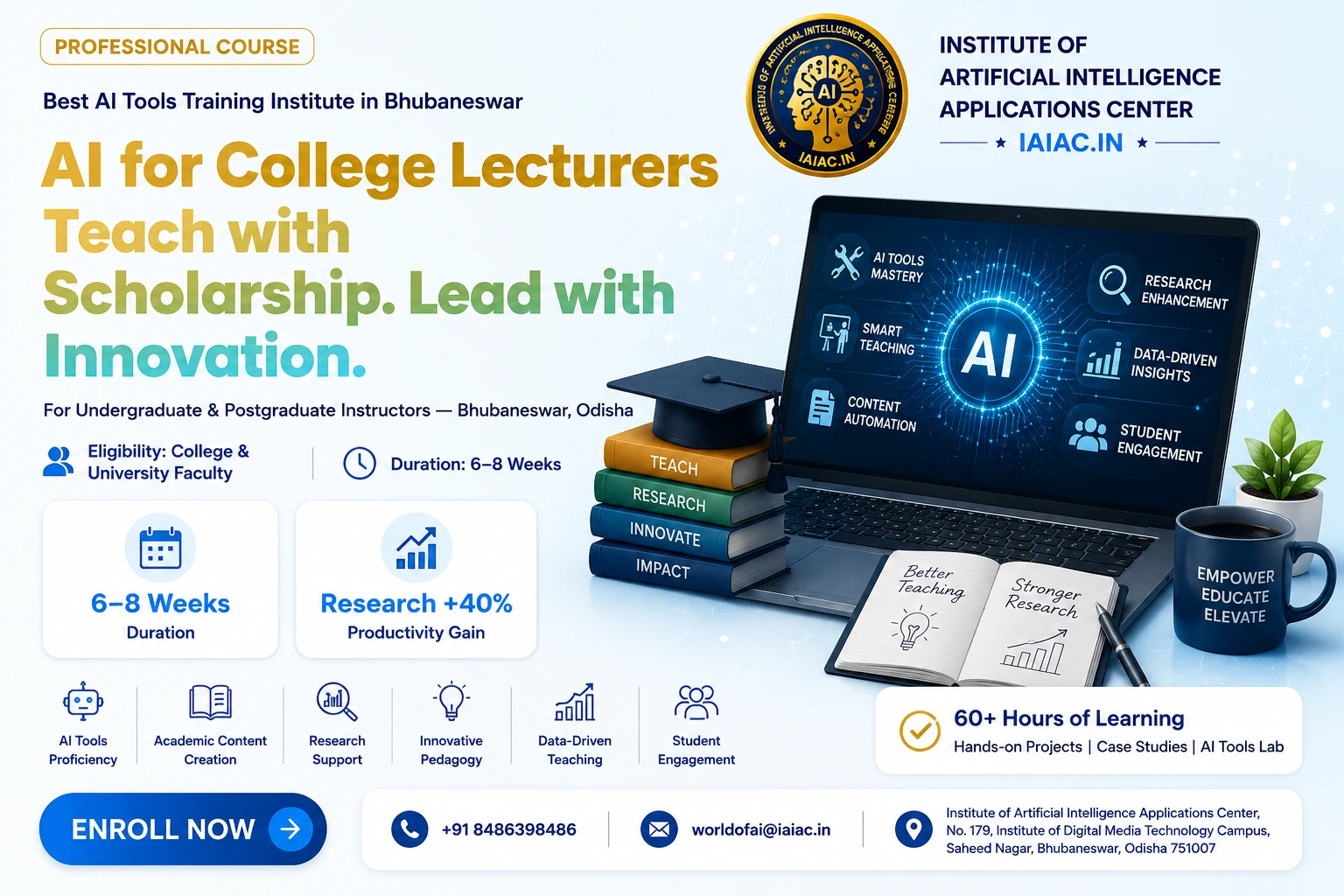
Empower educators with AI tools for research, lesson planning, assessment, and student engagement.
Level: beginner Duration: 2 Months
Curriculum
Module 1: AI Foundations for Higher Education
Tools: Elicit, Claude / ChatGPT-4o, Turnitin AI
- How transformer models and large language models work: a technically informed foundation — training data composition, parameter scale, context window limitations, and why AI models confidently produce academically incorrect outputs
- AI in higher education globally in 2025: how research-intensive universities, liberal arts colleges, and professional schools are responding to AI — from bans to full integration mandates and everything between
- The epistemological challenge: what it means for truth, knowledge, and scholarship when an AI can generate a plausible-sounding academic argument it does not actually 'know'
- Subject-discipline AI capability audit: assessing AI strength and weakness in your specific discipline — STEM fields, social sciences, humanities, law, business, medicine, and the arts respond to AI very differently
- Institutional AI policy landscape: understanding your institution's current position on AI use in teaching, research, examination, and publication — and how policies are evolving globally
- Academic publishing and AI: current policies of major journals (Nature, Elsevier, Springer, Wiley, Taylor & Francis) on AI use in manuscript preparation — and the disclosure obligations they impose
- Research ethics and AI: IRB/ethics committee considerations when AI tools are used in data collection, analysis, or reporting of human subjects research
- Higher education data protection: FERPA (US), GDPR (EU), and DPDP Act (India) requirements for student data — with specific implications for AI tools used in teaching and assessment
- Hands-on Activity: Conduct a discipline-specific AI capability audit — identify the five tasks in your teaching and research practice where AI offers genuine value, and five where AI presents unacceptable risk
Module 2: AI-Powered Curriculum Design & Lecture Development
Tools: Google NotebookLM, Microsoft Copilot in Education, Canva for Education
- AI-assisted course design: generating complete course syllabi with learning outcomes, reading lists, assessment designs, and weekly session plans aligned to university and discipline standards
- Bloom's Taxonomy integration: using AI to ensure learning outcomes, lecture content, and assessments are appropriately distributed across cognitive levels — from recall to critical evaluation and creation
- Research-teaching integration: using AI to identify and synthesise the most recent high-impact research relevant to each module's topic — ensuring lectures reflect the current state of the field
- Lecture slide and notes generation: AI drafting initial lecture slide structures, speaker notes, and reading summaries that the academic then enriches with discipline expertise and current research
- Seminar and tutorial design: generating discussion questions, case studies, problem sets, and structured debate materials that challenge students to apply, analyse, and evaluate
- Postgraduate curriculum design: developing research methods courses, literature review workshops, and dissertation preparation seminars with AI support
- International and culturally diverse content: using AI to identify gaps in Eurocentric or Western-centric curricula and generate supplementary content that broadens intellectual perspectives
- Open Educational Resources (OER): using AI to create, adapt, and share freely accessible teaching materials that contribute to the global higher education commons
- Hands-on Activity: Redesign one of your current modules using AI — update the syllabus, integrate three recent high-impact papers, and generate a complete seminar discussion plan for one topic
Module 3: University-Level Assessment Design in the AI Era
Tools: Gradescope, Exam.net, Socrative
- The crisis of the written essay: why the traditional take-home essay has become untrustworthy as an assessment instrument — and the range of alternatives that measure what it was always intended to measure
- Assessment design principles for the AI era: authenticity, process evidence, oral defence, portfolio, and performance-based assessment formats that require demonstrable genuine engagement
- Oral examination design with AI: preparing structured viva questions, marking rubrics, and standardisation protocols for oral assessment at undergraduate and postgraduate level
- Portfolio and process-based assessment: designing coursework that captures thinking-in-progress — drafts, annotations, reflection logs, and revision histories that AI cannot fabricate retroactively
- AI as an assessment tool: assignment designs that explicitly require students to use AI and then critically evaluate, annotate, and improve AI outputs — measuring higher-order thinking
- Assessment rubric design with AI: generating detailed, multi-criterion rubrics for complex university assignments — essays, reports, presentations, research projects, and creative work
- Examination question generation: AI producing varied, high-quality examination questions at the appropriate cognitive and complexity level for your module
- Grade descriptors and moderation: using AI to generate clear grade descriptor language and to support consistency in marking across module teams
- Hands-on Activity: Redesign one current assessment in your module to be AI-era appropriate — maintain or increase intellectual rigour while building in process evidence or oral defence requirements
Module 4: Scholarly Feedback, Marking & Student Communication
Tools: Gradescope, Grammarly Business, Brisk Teaching
- Scholarly feedback principles: the difference between surface correction and genuine intellectual engagement — and how AI can help deliver the latter at scale
- AI-assisted essay marking: applying complex university marking rubrics to student essays and generating multi-dimensional, criterion-specific feedback that identifies both strengths and specific improvement pathways
- Discipline-specific feedback language: using AI to generate technically appropriate, field-specific feedback that uses the vocabulary and analytical conventions of the discipline
- Feedback literacy development: using AI to help students understand, internalise, and act on the feedback they receive — not just read and discard it
- Dissertation and thesis chapter feedback: AI-assisted structural, argumentative, and methodological feedback on major supervised student work
- Research proposal feedback: generating detailed, specific feedback on undergraduate and postgraduate research proposals against institutional and disciplinary standards
- Student email management: using AI to draft professional, empathetic, consistent responses to the high volume of student queries — maintaining office hour quality in email form
- Progress reports and student profiles: AI-assisted academic progress reports, personal tutor notes, and at-risk student referral documentation
- Hands-on Activity: Mark a set of five student essays using an AI-assisted workflow — apply rubric, generate feedback, review and edit each set of comments, and compare time and quality to traditional approach
Module 5: Dissertation Supervision & Research Skills Development
Tools: Elicit, ResearchRabbit, Zotero + AI Plugins
- AI for literature review support: teaching students to use AI to map a research field, identify seminal works, trace theoretical evolution, and identify gaps — then critically verify every citation independently
- Research question development: using AI in supervision sessions as a Socratic tool — generating alternative research questions, identifying methodological implications, and challenging assumed premises
- Methodology coaching with AI: AI explaining research methods at the appropriate level of technical depth — qualitative and quantitative approaches, research design, validity, reliability, and ethics
- Dissertation chapter planning: AI generating structural outlines for introduction, literature review, methodology, findings, and discussion chapters — then student and supervisor critically developing from AI scaffold
- Academic writing development at the postgraduate level: AI providing paragraph-level, argument-level, and structure-level feedback on dissertation drafts
- Citation management and reference integrity: using AI to check bibliographies, identify incomplete citations, and verify source accessibility — but not to generate references the student has not actually read
- Supervision meeting preparation: AI helping supervisors prepare structured, productive, meeting-efficient supervision agendas based on the student's current chapter and progress
- Research skills curriculum design: using AI to build systematic research skills programs — from research question formulation through to academic writing and viva preparation
- Hands-on Activity: Prepare for a supervision meeting with a real or simulated postgraduate student using AI — review their draft chapter with AI assistance, generate structured feedback, and produce a targeted supervision agenda
Module 6: AI for Research, Scholarship & Academic Publishing
Tools: Semantic Scholar, GitHub Copilot / Cursor, ATLAS.ti / NVivo AI
- AI for systematic literature review: using tools like Elicit, Semantic Scholar AI, and ResearchRabbit to map research fields, identify high-citation papers, and synthesise findings at scale
- AI-assisted manuscript drafting: using AI to draft section outlines, generate initial literature synthesis paragraphs, and produce discussion sections — then the scholar substantively rewrites, verifies, and adds original intellectual contribution
- Journal submission process support: using AI to identify appropriate target journals, analyse author guidelines, generate cover letters, and structure rebuttal letters responding to reviewer comments
- Grant proposal writing with AI: AI-assisted literature sections, impact statements, and research methodology descriptions for grant applications — saving significant preparation time
- Research data analysis support: using AI coding assistants (GitHub Copilot, Claude) to support statistical analysis in R and Python — with rigorous verification of all outputs
- Conference abstract and presentation preparation: AI drafting conference abstracts and generating presentation structures from research findings
- Research impact and dissemination: using AI to write plain-language summaries, blog posts, media communications, and social media threads that extend research reach beyond academic publishing
- AI disclosure and attribution in scholarship: understanding and complying with journal, institution, and conference policies on AI use disclosure in academic work
- Hands-on Activity: Use AI to conduct a rapid literature synthesis on a current research topic — use Elicit or a similar tool to identify 10 key papers, generate a synthesised summary, and critically evaluate AI's coverage of the field against your own knowledge
Module 7: AI Ethics, Institutional Policy & Academic Integrity
Tools: Turnitin AI Detection, Exam.net, Google NotebookLM
- Building institutional AI policy: frameworks for university AI use policies that are clear, consistent, discipline-appropriate, and enforceable — with examples from leading institutions globally
- Academic integrity in the AI era: moving from detection-focused to education-focused approaches — building student AI literacy as the primary intervention
- AI detection tools in higher education: their capabilities, limitations, and the dangerous accuracy gaps that make AI detection tools alone an insufficient or unjust enforcement mechanism
- The academic misconduct process and AI evidence: how AI detection outputs interact with academic misconduct investigations — what constitutes sufficient evidence and what does not
- Discipline-specific AI ethics: the different ethical considerations of AI use in medical education, law education, social work training, and research-intensive disciplines
- AI and equity in higher education: ensuring AI tools do not disadvantage first-generation, ESL, or under-resourced students — and how institutional policy can actively promote equitable access
- Teaching AI ethics as a subject: integrating AI ethics, AI literacy, and AI governance into undergraduate and postgraduate curricula across all disciplines
- Faculty development in AI: designing and delivering AI professional development for academic colleagues — building institutional capacity for responsible AI integration
- Hands-on Activity: Draft an AI acceptable use policy for your own module — suitable for student-facing communication, clear on what is permitted and prohibited, and professionally defensible if challenged
Career Outcomes
- AI-Enhanced Subject Lecturer — ₹10,00,000: Lead intellectually rigorous, research-integrated classrooms using AI tools that save time and improve student outcomes across undergraduate and postgraduate levels.
- Assessment Innovation Lead — ₹11,00,000: Design and implement AI-era appropriate assessments — oral defences, process portfolios, performance tasks — that measure genuine intellectual development.
- Postgraduate Supervision Specialist — ₹12,00,000: Transform dissertation and thesis supervision with AI-assisted literature mapping, methodology coaching, and structured chapter feedback workflows.
- Academic Integrity Coordinator — ₹11,50,000: Develop and implement institutional AI policies, design AI-proof assessments, and teach responsible AI use to students and academic staff.
- AI Literacy Curriculum Lead — ₹10,50,000: Integrate AI ethics, AI capability, and critical AI use across the curriculum — preparing students for AI-transformed professional careers.
- Research Productivity Advisor — ₹12,50,000: Support colleagues in accelerating systematic literature reviews, manuscript preparation, and grant writing with AI — while maintaining scholarly integrity.
- EdTech Integration Specialist — ₹11,00,000: Evaluate, implement, and train academic colleagues on AI educational and research tools with focus on pedagogy, institutional compliance, and student outcomes.
- Faculty Development Facilitator — ₹10,00,000: Train academic colleagues in responsible, effective AI use for higher education teaching and research — becoming your institution's go-to expert for AI integration.
Frequently Asked Questions
Do I need technical skills or coding experience for this course?
Not at all. This course is designed for academics — not IT specialists. Every AI tool is approached from a scholarly perspective, with step-by-step guidance focused on immediate teaching and research application. No coding required.
How does the course handle student data protection and privacy?
Data protection is woven throughout every module. You'll learn FERPA (US), GDPR (EU), and DPDP Act (India) requirements for student data. We teach safe practices: what information can be entered into commercial AI tools, what requires anonymisation, and how to build an AI acceptable use policy for your module that complies with institutional and regulatory standards.
Which AI tools will I learn to use?
You'll master academic-specific platforms including Elicit for systematic literature review, Claude/ChatGPT-4o for scholarly drafting and analysis, Gradescope for AI-assisted marking, ResearchRabbit for citation network mapping, Semantic Scholar for research discovery, Google NotebookLM for document-based reasoning, and Turnitin AI for academic integrity monitoring. All tools are selected for immediate academic ROI and institutional compliance.
Is this suitable for lecturers across different disciplines?
Absolutely. The curriculum is built for higher education faculty across all disciplines — STEM fields, social sciences, humanities, law, business, medicine, and the arts. We cover alignment to undergraduate and postgraduate standards, with discipline-specific examples and subject-specialist AI capability audits throughout.
What does the capstone project involve?
You will produce a complete AI-enhanced academic portfolio demonstrating integration across teaching and research practice. It must include: (1) One redesigned module — syllabus, session plans, and research-integrated lecture materials, (2) One AI-era assessment design with detailed rubric, grade descriptors, and academic integrity guidance, (3) Five examples of AI-assisted scholarly feedback on student work, (4) A postgraduate supervision workflow with AI-assisted chapter feedback example, (5) An AI-assisted literature synthesis on a current research topic with critical evaluation of AI coverage, and (6) A module-level AI acceptable use policy suitable for institutional adoption. Submit with a scholarly reflection on the epistemological, ethical, and pedagogical dimensions of AI integration in your discipline.
Can AI really help me save time on teaching and research?
Yes. Lecturers who complete this course typically reclaim 40%+ time from manual literature review, lesson planning, marking, and manuscript drafting. AI handles the repetitive drafting, synthesis, and formatting, freeing you to focus on what matters most: scholarly judgment, intellectual engagement with students, and original research contribution.
Will I work on practical teaching and research projects during the course?
Yes. Every module includes hands-on activities using your actual teaching and research context. You'll redesign a module syllabus, create AI-era assessments, mark student essays with AI assistance, prepare a supervision meeting with AI support, and conduct a rapid literature synthesis — all using real AI tools you can deploy immediately in your academic practice.
Do you provide certification after completing the course?
Yes. Students receive an IAIAC Industry-Recognised Certificate after successfully completing the AI for College Lecturers course, practical academic portfolio, and capstone project. This certification validates your AI-augmented teaching and research capabilities to institutional leadership, promotion committees, and professional academic networks.
Are online and offline learning options available?
Yes. We offer flexible learning options including offline campus training in Bhubaneswar, online live sessions, and hybrid modes to support working academics. All participants receive access to recorded sessions, resource libraries, and ongoing community support.
Why should college lecturers learn AI today?
AI is transforming higher education — from research-integrated teaching to automated scholarly feedback to accelerated literature synthesis. Lecturers who embrace AI now gain a significant advantage: they can design more rigorous curricula, provide richer feedback, accelerate their research, and focus energy on the intellectual leadership that machines cannot replicate. This course prepares you to lead that transition confidently, ethically, and institutionally compliant.
ସ୍ପଷ୍ଟୀକରଣ: ଏହି ବିଷୟବସ୍ତୁଟି ସୂଚନାମୂଳକ ଉଦ୍ଦେଶ୍ୟରେ IAIAC : Institute of Artificial Intelligence and Applications Center ରୁ ସ୍ୱୟଂଚାଳିତ ଭାବରେ ସଂଗ୍ରହ କରାଯାଇଛି। ମୂଳ ଲେଖାଟି ପଢ଼ିବା ପାଇଁ, ଦୟାକରି ଏଠାରେ ଦେଖନ୍ତୁ।

Odisha Press & Media
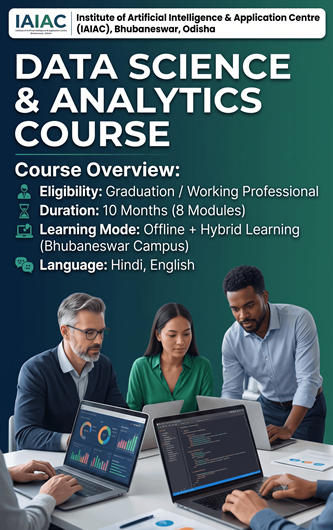
Learn Data Science & Analytics at IAIAC.IN
Learn in-demand data skills with hands-on projects and mentor support.





/sambad/media/media_files/2026/09/17/hfshsfhxvvxv-2026-09-17-02-21-40.jpg)
/sambad/media/media_files/2026/08/21/sfhsffsfhfhs-2026-08-21-02-22-21.jpg)
/sambad/media/media_files/2026/08/10/adgdagadggd-2026-08-10-01-17-24.jpg)

/sambad/media/media_files/2026/08/10/elephant-2026-08-10-01-13-06.jpg)