Natural Language Processing
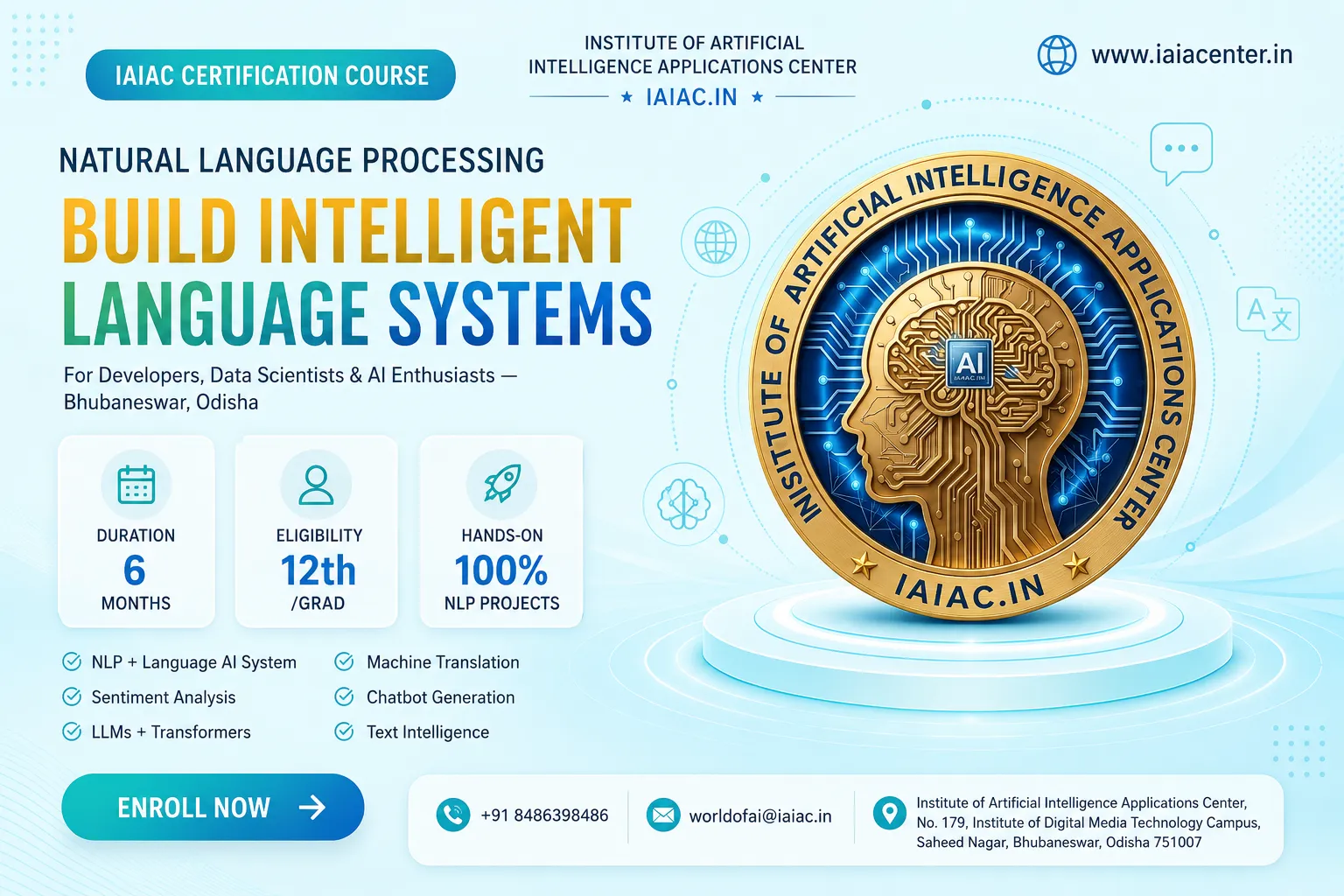
Develop chatbots, language models, sentiment analysis systems, and intelligent text applications.
Level: intermediate Duration: 6 Months
Curriculum
Module 1: Python & NLP Fundamentals
Tools: Python 3, NLTK, spaCy
- Python basics for NLP workflows
- Text preprocessing and tokenization
- Stemming and lemmatization
- Stop-word removal systems
- N-grams and bag-of-words
- TF-IDF vectorization techniques
Module 2: Word Embeddings & Representations
Tools: Gensim, Word2Vec
- One-hot encoding limitations
- Word2Vec CBOW and Skip-gram
- GloVe vector representations
- FastText subword embeddings
- Contextual versus static embeddings
- Vector similarity search
Module 3: Deep Learning for NLP
Tools: TensorFlow, PyTorch, Keras
- RNNs for sequence modeling
- LSTM and GRU architectures
- Bidirectional recurrent networks
- Sequence-to-sequence models
- Attention mechanisms
- Encoder-decoder architectures
Module 4: Transformers & Modern NLP
Tools: Hugging Face, BERT, GPT
- Transformer architecture fundamentals
- BERT bidirectional training
- GPT generative pretraining
- T5 text-to-text transfer
- RoBERTa and DistilBERT
- Fine-tuning transformer models
Module 5: NLP Applications
Tools: Rasa, DialogFlow, LangChain
- Sentiment analysis systems
- Named entity recognition
- Text classification techniques
- Question answering systems
- Text summarization workflows
- Machine translation pipelines
Module 6: Chatbots & Conversational AI
Tools: OpenAI API, Gemini API
- Intent classification systems
- Dialog management workflows
- Context-aware conversation handling
- Chatbot framework integration
- LLM-powered conversational systems
- Deployment and scaling strategies
Career Outcomes
- NLP Engineer — ₹7,50,000: Build and deploy language models for text analysis and chatbots.
- Conversational AI Developer — ₹8,20,000: Design intelligent chatbots for customer service automation.
- Text Analytics Specialist — ₹6,80,000: Extract insights from unstructured text using NLP techniques.
- LLM Engineer — ₹10,00,000: Fine-tune and deploy large language models for enterprise apps.
- Speech Recognition Engineer — ₹7,20,000: Develop voice-to-text systems for accessibility.
- Search Engineer — ₹8,50,000: Build semantic search engines with query understanding.
- Content Moderation AI Developer — ₹6,50,000: Create AI systems to detect harmful content and spam.
- Translation Systems Engineer — ₹7,80,000: Build neural machine translation for global platforms.
- Information Extraction Specialist — ₹7,00,000: Design systems to extract structured data from documents.
- NLP Research Scientist — ₹12,00,000: Conduct cutting-edge research in language understanding.
Frequently Asked Questions
What is the Natural Language Processing (NLP) course?
The Natural Language Processing (NLP) course is a specialized Artificial Intelligence program focused on teaching machines to understand, analyze, interpret, and generate human language. Students learn text analysis, chatbots, language models, sentiment analysis, speech processing, and AI-powered communication systems.
Who should join the NLP course?
This course is ideal for students, AI enthusiasts, software developers, Machine Learning learners, data professionals, content technology specialists, researchers, and working professionals interested in language-based Artificial Intelligence systems and intelligent communication technologies.
Do I need coding knowledge for the NLP course?
Basic programming knowledge, especially in Python, is helpful for understanding NLP workflows and AI model development. However, beginner-friendly guidance is also provided for learners who are new to Artificial Intelligence and language technologies.
What skills will I learn in the Natural Language Processing course?
Students will learn text processing, chatbot development, sentiment analysis, language modeling, speech processing concepts, AI communication systems, prompt engineering, text classification, automation workflows, and practical Natural Language Processing application development.
How is Natural Language Processing used in real-world industries?
Natural Language Processing is widely used in industries such as customer support, healthcare, education, finance, digital marketing, e-commerce, media technology, and business automation for chatbots, voice assistants, content analysis, translation systems, and intelligent communication platforms.
Which tools and technologies are covered in the NLP course?
Students will gain practical exposure to modern NLP frameworks, language processing libraries, AI communication tools, chatbot development workflows, text analysis systems, and real-world Artificial Intelligence implementation techniques used in industry projects.
Will I work on practical NLP and chatbot projects?
Yes. Students will work on hands-on projects involving chatbot development, text analysis systems, AI-powered communication tools, language automation workflows, and portfolio-building assignments designed to develop industry-ready skills.
What career opportunities are available after completing the NLP course?
After completing this course, students can pursue career opportunities such as NLP Engineer, AI Engineer, Chatbot Developer, Machine Learning Engineer, AI Research Associate, Conversational AI Specialist, Data Scientist, and Language Technology Developer.
Do you provide certification after course completion?
Yes. Students receive an industry-recognized certification after successfully completing the Natural Language Processing course, practical projects, and assessment-based learning activities.
Why should I learn Natural Language Processing today?
Natural Language Processing is one of the fastest-growing fields in Artificial Intelligence and powers technologies such as chatbots, virtual assistants, language translation systems, AI search tools, and content automation platforms. Learning NLP helps students access high-demand career opportunities in AI-driven communication and automation industries.
ସ୍ପଷ୍ଟୀକରଣ: ଏହି ବିଷୟବସ୍ତୁଟି ସୂଚନାମୂଳକ ଉଦ୍ଦେଶ୍ୟରେ IAIAC : Institute of Artificial Intelligence and Applications Center ରୁ ସ୍ୱୟଂଚାଳିତ ଭାବରେ ସଂଗ୍ରହ କରାଯାଇଛି। ମୂଳ ଲେଖାଟି ପଢ଼ିବା ପାଇଁ, ଦୟାକରି ଏଠାରେ ଦେଖନ୍ତୁ।

Odisha Press & Media
Learn Data Science & Analytics at IAIAC.IN
Learn in-demand data skills with hands-on projects and mentor support.






/sambad/media/media_files/2026/09/17/hfshsfhxvvxv-2026-09-17-02-21-40.jpg)
/sambad/media/media_files/2026/08/21/sfhsffsfhfhs-2026-08-21-02-22-21.jpg)
/sambad/media/media_files/2026/08/10/adgdagadggd-2026-08-10-01-17-24.jpg)

/sambad/media/media_files/2026/08/10/elephant-2026-08-10-01-13-06.jpg)