AI for High School Teachers
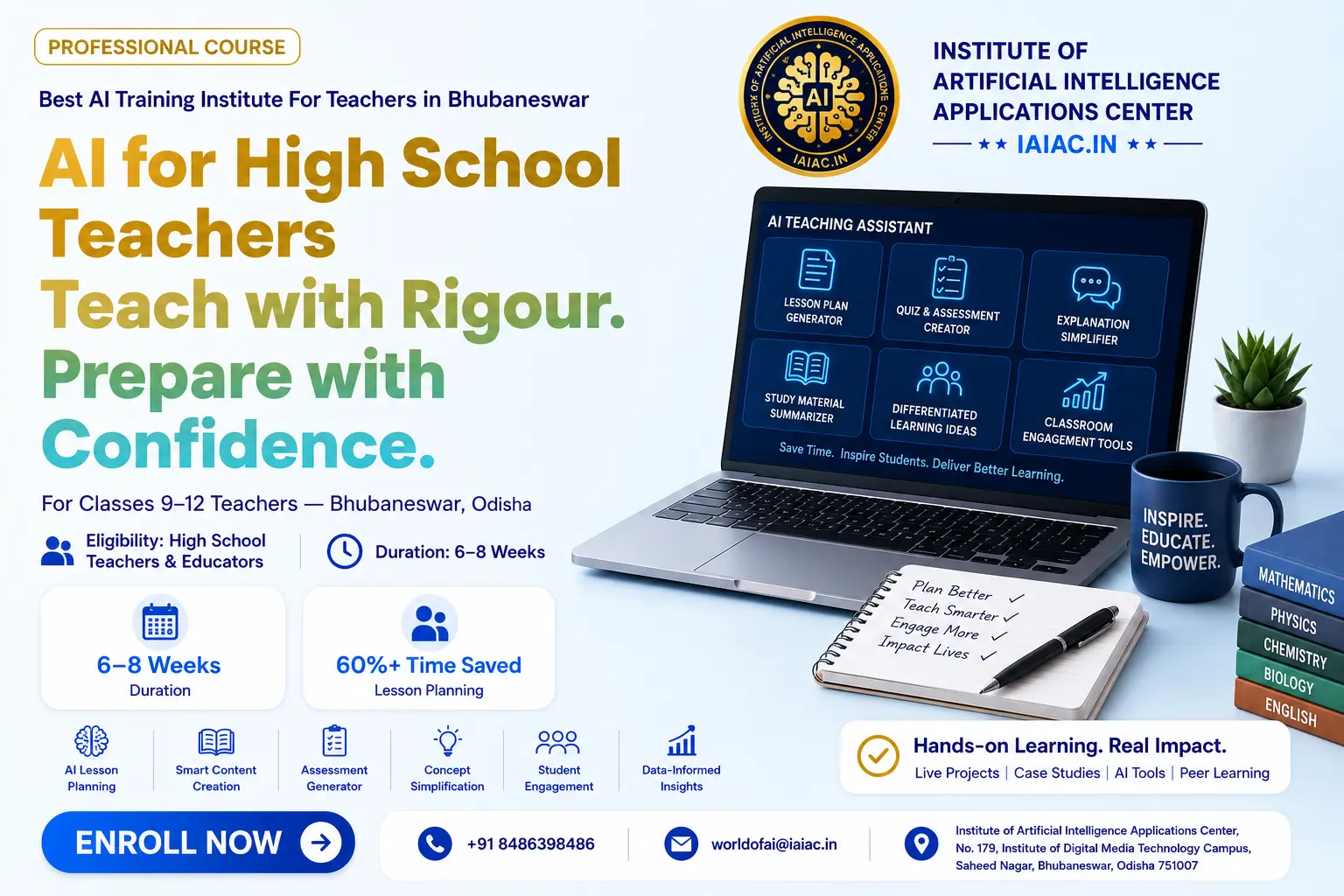
Introduce teachers to AI concepts, problem solving, creativity, and future-ready technology skills.
Level: Beginner Duration: 2 Months
Curriculum
Module 1: AI Foundations for High School Educators
Tools: Magic School AI, Turnitin AI, Google NotebookLM
- How large language models work: a teacher's technical foundation — training data, context windows, hallucinations, and why AI can write convincingly about things it does not actually know
- AI in the high school context in 2025: how leading independent schools, state schools, and international schools are using AI — and the wild variation in approaches that currently exists
- The examination board landscape and AI: understanding current CBSE, ICSE, CISCE, IB, Cambridge (IGCSE/A-Level), and College Board (AP) policies on AI use by students and schools
- Subject-specific AI capability: what AI is genuinely good at in Mathematics vs. Literature vs. Sciences vs. Social Sciences — and where it fails in each discipline
- AI hallucination in academic contexts: the specific risks when AI confidently fabricates historical dates, scientific findings, or literary quotations in student work
- Professional ethics for high school AI use: the teacher's responsibility when using AI in reference letters, predicted grades, and assessment feedback
- Data protection for adolescent students: additional safeguards required when AI tools may process data related to students under 18
- Evaluating AI tools for school adoption: a structured framework for assessing data privacy, curriculum alignment, and educational soundness of AI platforms
- Hands-on Activity: Test the same subject-specific task across three AI tools; evaluate each for accuracy, hallucination risk, and curriculum alignment — produce a one-page critical assessment
Module 2: Subject-Specialist AI for Science Teachers
Tools: Khan Academy Khanmigo, Gradescope, Canva for Education
- AI for science lesson planning: generating structured lessons with learning objectives, teaching sequences, and practical activities aligned to Class 9–12 board syllabi
- Generating science explanations at the right level: using AI to produce explanations of complex concepts that are accurate, accessible, and free from the over-simplification that misleads exam candidates
- Laboratory practical planning with AI: designing practical sessions, risk assessments, method cards, and result analysis guides
- Numerical problem generation: AI generating sets of physics and chemistry calculation problems at graded difficulty levels with worked solutions
- Diagram and visual creation: using AI-assisted tools to produce high-quality scientific diagrams, reaction diagrams, biological illustrations, and data graphs
- AI for examination mark scheme interpretation: using AI to map student answers against mark schemes and identify specific point-by-point gaps
- Science misconception identification: AI generating common student misconceptions for a topic along with the targeted explanations that correct each one
- Cross-disciplinary STEM connections: using AI to design project-based learning activities that connect Physics, Chemistry, Biology, and Mathematics authentically
- Hands-on Activity: Generate a complete practical lesson plan — including risk assessment, method guide, results table, and exam-style analysis questions — for a current Class 11–12 topic
Module 3: Subject-Specialist AI for Humanities Teachers
Tools: Claude / ChatGPT-4o, Curipod, Brisk Teaching
- AI for history and social science lesson planning: generating lessons that teach historical thinking, source analysis, and interpretive skills — not just facts
- Primary source analysis support: using AI to contextualise historical documents, generate discussion questions, and scaffold student source analysis
- Essay question generation with mark schemes: AI producing exam-quality questions with detailed mark schemes for any topic in history, geography, political science, or economics
- Analytical model explanations: using AI to explain economic models, political theories, and sociological frameworks at the right level of sophistication for Class 9–12
- Case study generation for geography and economics: AI creating realistic, data-rich case studies for current or historical events
- Debate and discussion material: AI generating structured debate resources — claim, counterclaim, evidence, and refutation — for any significant historical or social issue
- Fiction and non-fiction literature resources: using AI to generate comprehension questions, analytical frameworks, and thematic analysis scaffolds for set texts
- Research skill development: using AI to teach students how to formulate research questions, evaluate sources, and build evidence-based arguments — with AI as a modelling tool
- Hands-on Activity: Create a complete source analysis lesson for a Class 10 history topic — including background context, three differentiated source sets, analytical questions, and a mark scheme
Module 4: Examination Preparation & Revision Systems
Tools: Socrative, Quizizz AI, Diffit
- AI past paper analysis: training AI to identify the most frequently tested topics, question types, and mark-scheme patterns across 5–10 years of examination papers
- Spaced repetition systems with AI: generating optimally sequenced revision schedules that exploit the spacing effect to maximise retention
- Personalised revision plans: using AI to create individual examination preparation plans based on each student's topic-by-topic assessment data
- AI-generated examination practice: producing exam-standard questions on demand — timed, formatted to examination specification, and accompanied by detailed mark schemes
- Examiner's report analysis: using AI to extract the most important feedback patterns from official examiner reports and translate them into specific student guidance
- Model answer generation and critique: using AI to produce model answers that are then systematically critiqued with students — developing evaluative capacity
- Common error catalogues: AI generating subject-specific catalogues of frequent examination errors with the diagnostic explanations and targeted exercises that correct each one
- Mock examination management: using AI to generate full mock papers, manage marking workflows, and produce class-level and individual diagnostic reports
- Hands-on Activity: Analyse five years of a board examination paper using AI — identify high-frequency topics, generate a 10-question targeted practice set with mark scheme, and produce a class revision priority list
Module 5: Complex Feedback, References & University Preparation
Tools: Gradescope, Grammarly Business, Microsoft Copilot in Education
- AI-assisted essay marking: applying complex analytical rubrics (IB Criterion-based, A-Level Band descriptors, AP Scoring Guides) to student essays and generating detailed, criterion-specific feedback
- University reference letter drafting: using AI to produce compelling, highly personalised reference letters from structured teacher notes — maintaining the teacher's voice and professional judgment throughout
- Personal statement feedback: AI providing structured, specific feedback on student personal statements against university admissions criteria
- Internal assessment and coursework support: using AI to clarify criteria, generate planning prompts, and provide formative feedback on IB Extended Essays, NEAs, and coursework projects
- Research skills for high school: teaching students to use AI as a research tool — generating research questions, identifying source types, and distinguishing primary from secondary evidence
- Academic writing development: using AI to provide sentence-level, paragraph-level, and structural feedback on student academic writing
- Subject-specific vocabulary development: AI generating domain vocabulary flashcard systems, etymology explorations, and subject-specific glossaries for Class 9–12
- Progress reports and student profiles: using AI to draft accurate, specific, professional progress reports for parents and school records
- Hands-on Activity: Draft a university reference letter for a real or anonymised student using AI — from raw teacher notes to a publication-ready reference — and evaluate it against actual admissions criteria
Module 6: Academic Integrity, AI Literacy & the Future-Ready Student
Tools: Turnitin AI Detection, Exam.net, Google NotebookLM
- The AI-enabled student in 2025: what students are already doing with AI outside the classroom — and why ignoring it is no longer a viable school policy
- Designing AI-proof assessments: shifting from take-home essays to in-class writing, oral examinations, process portfolios, and performance tasks that demonstrate genuine understanding
- Teaching AI as a subject: integrating AI ethics, AI literacy, and AI capability into existing curricula across all subjects — not just computing
- The Socratic AI classroom: using AI as an intellectual sparring partner — asking AI to take a position, argue a case, or defend a theory — and teaching students to critically interrogate AI reasoning
- Citation and attribution in the AI era: developing clear school policies on how students acknowledge AI assistance in line with emerging international academic conventions
- AI detection tools: understanding their capabilities and limitations — and why they cannot replace relationship-based assessment and process evidence
- Digital well-being and AI: supporting students in developing healthy relationships with AI tools — avoiding cognitive offloading, maintaining effort and persistence
- Career readiness and AI: helping students understand the AI-transformed labour market they are entering and the skills — creativity, judgment, communication, collaboration — that remain human advantages
- Hands-on Activity: Design and teach a 40-minute lesson that uses AI as a teaching tool rather than a productivity shortcut — students interact with AI critically, evaluate its outputs, and produce work that demonstrates their own superior judgment
Career Outcomes
- AI-Enhanced Subject Teacher — ₹8,50,000: Lead rigorous, exam-focused classrooms using AI tools that save time and improve student outcomes across Science, Humanities, or Languages.
- Examination Preparation Specialist — ₹9,00,000: Design and deliver AI-powered past paper analysis, revision systems, and targeted practice that demonstrably improves board examination results.
- University Admissions Advisor — ₹9,50,000: Provide expert guidance on reference letters, personal statements, and research skills development using AI to enhance quality and personalisation.
- Academic Integrity Coordinator — ₹10,00,000: Develop and implement school-wide AI policies, design AI-proof assessments, and teach responsible AI use to students and staff.
- AI Literacy Curriculum Lead — ₹9,50,000: Integrate AI ethics and critical AI use across the curriculum — preparing students for university and AI-transformed careers.
- Subject Department Head (AI-Fluent) — ₹11,00,000: Lead subject teams in adopting AI tools for lesson planning, assessment, and professional development — becoming a school-wide AI champion.
- EdTech Integration Specialist — ₹10,00,000: Evaluate, implement, and train colleagues on AI educational tools with focus on pedagogy, examination compliance, and student outcomes.
- Teacher Professional Development Facilitator — ₹9,00,000: Train colleagues in responsible, effective AI use for high school teaching — becoming your school's go-to expert for AI teaching tools.
Frequently Asked Questions
Do I need technical skills or coding experience for this course?
Not at all. This course is designed for classroom teachers — not IT specialists. Every AI tool is approached from a practitioner's perspective, with step-by-step guidance focused on immediate classroom application. No coding required.
How does the course handle student data protection and privacy?
Data protection is woven throughout every module. You'll learn GDPR, DPDP Act (India), and school policy requirements for AI use with student data. We teach safe practices: what information can be entered into commercial AI tools, what requires anonymisation, and how to build an AI acceptable use policy for your classroom.
Which AI tools will I learn to use?
You'll master educator-specific platforms including Khanmigo for Socratic tutoring, Magic School AI for lesson planning, Turnitin AI for academic integrity, Gradescope for AI-assisted marking, Google NotebookLM for document-based learning, and Brisk Teaching for feedback automation. All tools are selected for immediate classroom ROI and curriculum alignment.
Is this suitable for teachers across different subjects and boards?
Absolutely. The curriculum is built for high school teachers across all subjects — Science, Mathematics, Social Studies, English, and regional languages. We cover alignment to CBSE, ICSE, State Boards, Cambridge, and IB curricula, with subject-specific examples throughout.
What does the capstone project involve?
You will build a complete AI-enhanced subject teaching portfolio for one current Class 9–12 course. It must include: a redesigned unit plan with subject-specific AI resources and differentiation, an examination preparation system with past paper analysis and practice questions, three examples of AI-assisted student feedback, a university reference letter drafted with AI, and a student AI literacy lesson design. Submit with a professional reflection on AI tool choices, quality review decisions, and evidence of impact on student learning.
Can AI really help me save time on lesson planning and marking?
Yes. Teachers who complete this course typically reclaim 60%+ time from manual lesson planning, resource creation, and formative assessment tasks. AI handles the repetitive drafting and formatting, freeing you to focus on what matters most: responsive teaching and student relationships.
Will I work on practical classroom projects during the course?
Yes. Every module includes hands-on activities using your actual teaching context. You'll create differentiated lesson plans, generate exam-aligned worksheets, build AI-powered quizzes, and design personalised support strategies — all using real AI tools you can deploy immediately in your classroom.
Do you provide certification after completing the course?
Yes. Students receive an IAIAC Industry-Recognised Certificate after successfully completing the AI for High School Teachers course, practical teaching portfolio, and capstone project. This certification validates your AI-augmented teaching capabilities to school leadership and professional networks.
Are online and offline learning options available?
Yes. We offer flexible learning options including offline campus training in Bhubaneswar, online live sessions, and hybrid modes to support working teachers. All participants receive access to recorded sessions, resource libraries, and ongoing community support.
Why should high school teachers learn AI today?
AI is transforming education — from personalised learning pathways to automated assessment feedback. Teachers who embrace AI now gain a significant advantage: they can differentiate instruction more effectively, provide richer feedback, and focus energy on the human aspects of teaching that machines cannot replicate. This course prepares you to lead that transition confidently and ethically.
About IAIACENTER.IN
The Institute of Artificial Intelligence Applications Center (IAIACENTER.IN) is a leading AI education and training institution based in Bhubaneswar, Odisha, India. Specializing in industry-oriented Certificate, Diploma, and Professional courses, IAIACENTER.IN is dedicated to building practical capabilities in Artificial Intelligence and emerging technologies. IAIACENTER.IN’s programs cover a wide spectrum of AI domains, including Artificial Intelligence, Machine Learning, Natural Language Processing (NLP), Deep Learning, Computer Vision, Cloud AI and MLOps, AI in Cybersecurity, Software Development, Data Science and Analytics, and Robotics and Automation. The institution also offers sector-specific AI training to empower professionals and organisations to apply AI in their respective fields. These tailored programs serve entrepreneurs, healthcare professionals, accountants and finance professionals, teachers and educators, content creators and media professionals, office and management professionals, students, and emerging professionals. Each program focuses on practical AI applications that enhance productivity and innovation, and promotes responsible adoption and effective integration of AI into professional workflows. Positioned as India’s first Safe, Trusted, and Reliable AI Applications Centre, IAIACENTER.IN is deeply committed to promoting Responsible AI across society. The institution emphasises the safe, ethical, transparent, reliable, and human-centred use of artificial intelligence, aiming to bridge the gap between rapidly evolving AI technologies and their responsible application in education, business, government, media, healthcare, and daily life.
ସ୍ପଷ୍ଟୀକରଣ: ଏହି ବିଷୟବସ୍ତୁଟି ସୂଚନାମୂଳକ ଉଦ୍ଦେଶ୍ୟରେ IAIAC Courses ରୁ ସ୍ୱୟଂଚାଳିତ ଭାବରେ ସଂଗ୍ରହ କରାଯାଇଛି। ମୂଳ ଲେଖାଟି ପଢ଼ିବା ପାଇଁ, ଦୟାକରି ଏଠାରେ ଦେଖନ୍ତୁ।

Odisha Press & Media
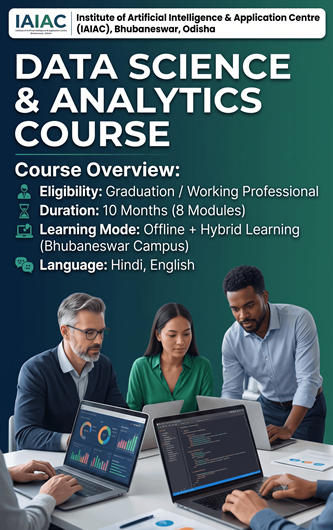
Learn Data Science & Analytics at IAIAC.IN
Learn in-demand data skills with hands-on projects and mentor support.

/sambad/media/media_files/2026/08/24/images-8-2026-08-24-21-58-24.jpg)
/sambad/media/media_files/2026/08/24/ouat-2026-08-24-21-08-28.jpeg)

/sambad/media/media_files/2026/09/06/06bbs_31_06092026_112-2026-09-06-19-37-35.jpg)